

INDUSTRY OPINION
Scaling Green Hydrogen in India: The Critical Role of EPC Companies
India’s green hydrogen ambitions are rapidly transitioning from policy vision to on-ground execution, driven by the National Green Hydrogen Mission and increasing industrial demand for clean fuels, decarbonisation, and energy security. As the country positions itself among leading green hydrogen manufacturing companies, the real inflection point lies in the ability to scale infrastructure—where EPC (Engineering, Procurement & Construction) companies are emerging as the backbone of India’s green hydrogen ecosystem. Leading players such as Nuberg Green Energy are increasingly recognised as a Green H2 EPC Contractor and GH2 EPC Contractor, enabling large-scale project deployment across sectors.
Green hydrogen projects are inherently complex, requiring seamless integration of water electrolysis, renewable energy integration, hydrogen storage, compression systems, and downstream utilisation. EPC players like Nuberg Green Energy are uniquely positioned to deliver end-to-end, single-point solutions, covering feasibility studies, technology selection, detailed engineering, procurement, fabrication, construction, and commissioning. This positions Nuberg among the most reliable green hydrogen EPC companies in India delivering turnkey project execution.
What differentiates Nuberg Green Energy is its 360-degree capability across the hydrogen value chain—from generation to purification, compression, storage, dispensing, and distribution. This integrated approach is critical in addressing one of the sector’s biggest challenges: scalability with cost efficiency, a key factor for industries evaluating green hydrogen project cost in India.
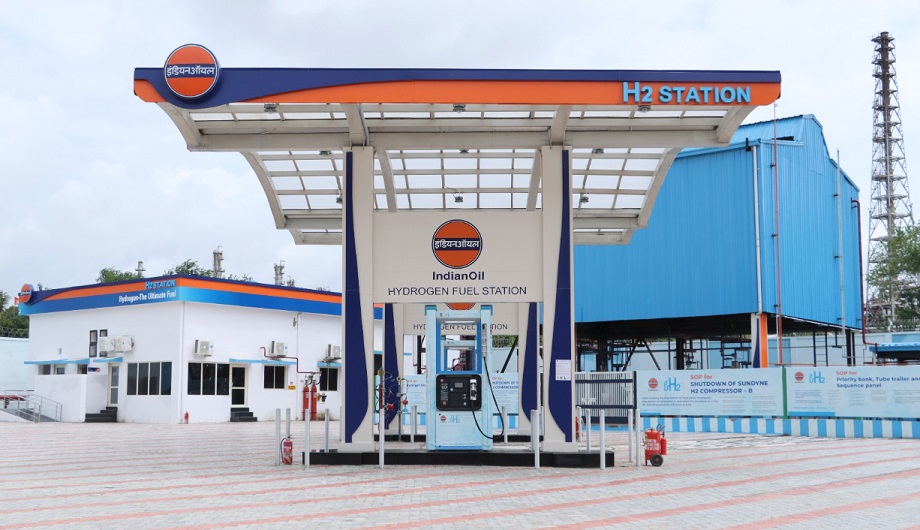
A key example of execution excellence is the hydrogen fuel station for Indian Oil Corporation Limited (IOCL) in Vadodara—India’s first commercial-scale hydrogen refuelling station. Designed and executed by Nuberg, the project includes hydrogen production, high-pressure compression, storage, and dispensing systems, enabling the adoption of fuel cell vehicles and supporting hydrogen mobility in India. This project reinforces Nuberg’s position as a leading GH2 EPC Contractor and sets a benchmark for future hydrogen refuelling infrastructure projects in India.

Similarly, Nuberg’s involvement in projects such as the green hydrogen plant for Hygenco Green Energy in Hisar highlights its role in enabling industrial decarbonisation. The Hisar facility—India’s first commercial-scale green hydrogen plant in the steel sector—demonstrates the growing demand for green hydrogen for steel industry applications and validates the commercial viability of green hydrogen in hard-to-abate sectors. Through such initiatives, Nuberg continues to strengthen its standing among top green hydrogen manufacturing companies and EPC solution providers.
What differentiates Nuberg Green Energy is its 360-degree capability across the hydrogen value chain—from generation to purification, compression, storage, dispensing, and distribution. This integrated approach is critical in addressing one of the sector’s biggest challenges: scalability with cost efficiency, a key factor for industries evaluating green hydrogen project cost in India.
Beyond hydrogen production, EPC companies are central to developing the green hydrogen derivatives ecosystem, particularly green ammonia (GNH3) and green methanol—critical for storage, transportation, and export markets. Nuberg Green Energy, as a trusted GNH3 EPC Contractor and among emerging green ammonia engineering companies, offers advanced solutions for ammonia synthesis, hydrogen-based chemicals, and export-ready infrastructure, positioning India as a global hub for green ammonia production and export.
Moreover, Nuberg’s capabilities extend into compressed biogas (CBG), 2G bioethanol, and green hydrogen-based chemicals, strengthening its portfolio across next-generation clean energy solutions. This diversified approach positions Nuberg as more than just an EPC contractor—it is a comprehensive partner for industries seeking low-carbon fuel alternatives and future-ready energy infrastructure.
In essence, while policy frameworks and investments are critical enablers, the success of green hydrogen in India ultimately depends on execution, scalability, and technological integration. EPC companies like Nuberg Green Energy are not merely contractors—they are strategic enablers of India’s energy transition, bridging the gap between ambition and implementation.
What lies ahead is not just expansion—but acceleration.As India moves from pilot projects to giga-scale deployments, the next phase will demand faster execution cycles, deeper sectoral integration, and globally competitive production economics. The focus will shift towards building large-scale hydrogen hubs, export-oriented green ammonia ecosystems, and integrated energy complexes that combine renewable generation, hydrogen production, and downstream utilisation under a single infrastructure framework.
EPC players will be at the centre of this transformation—driving standardisation, reducing project timelines, optimising costs, and embedding digital intelligence across the hydrogen value chain. Companies like Nuberg Green Energy are expected to lead this next wave by delivering scalable, modular, and future-ready solutions that can be replicated across industries and geographies.
As global demand for green molecules intensifies, India stands at the cusp of becoming not just a consumer, but a leading exporter of green hydrogen and its derivatives. The coming decade will define this trajectory—and the companies that can execute with precision, innovate with agility, and scale with confidence will shape the future of the hydrogen economy.
© This article was first published in New Delhi, 08 May, 2026.